
This is an automatic English translation of the Dutch original.
At Post-X Society we believe that the transition to a just, sustainable society calls not only for visions and plans, but above all for concrete experiments. That is why we don’t get stuck in criticism of the existing, but preferably actually try out something new as quickly as possible.
One such initiative is Integral: an open source, post-capitalist infrastructure that enables communities to meet their basic needs outside of money and markets. Built up from local hubs that reinforce one another, just as biodiversity makes an ecosystem more resilient.
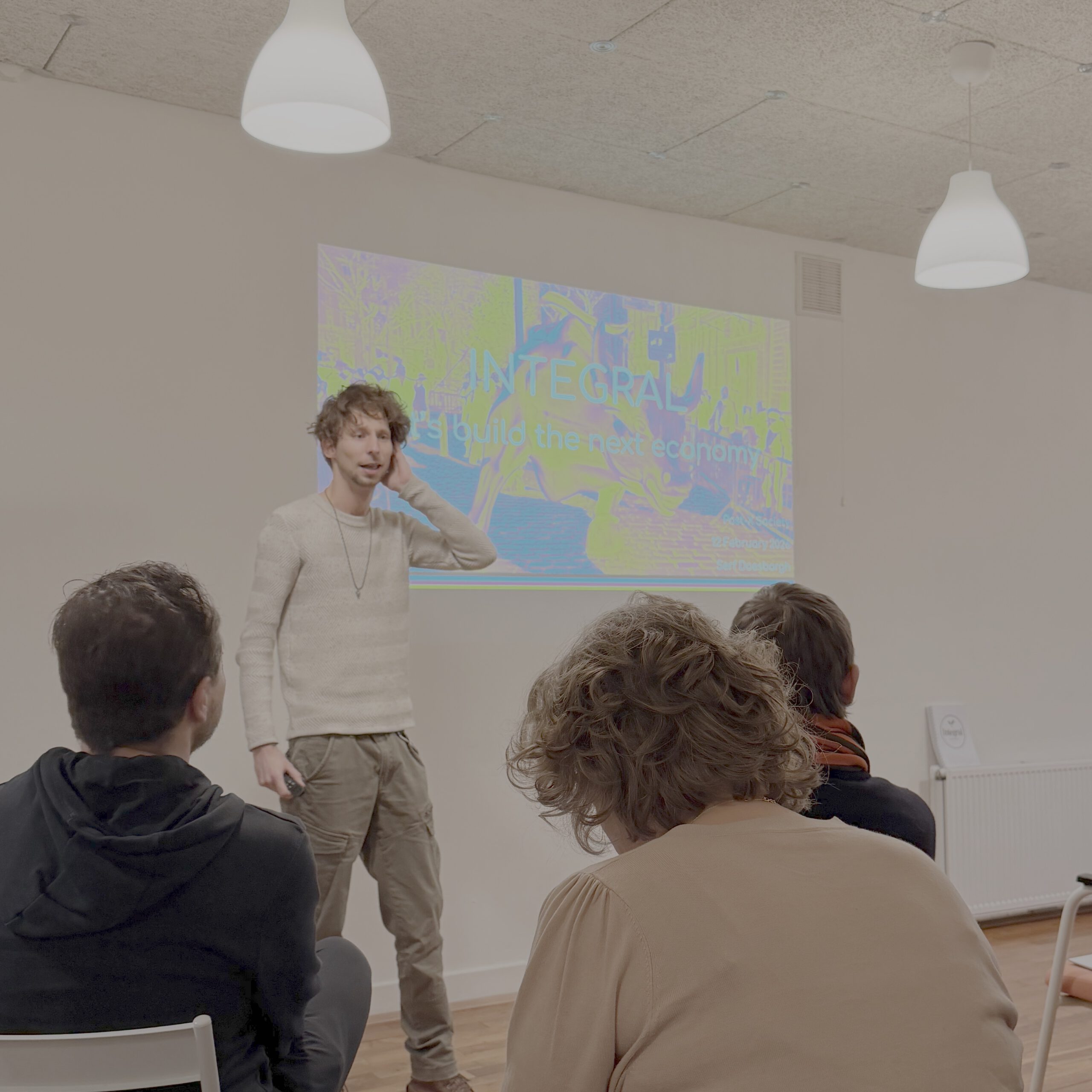
Our driving force Serf Doesborgh is taking the first steps in the Netherlands to get such a hub off the ground. In the interview below he tells us what moved him about the idea, why people react with both enthusiasm and scepticism, and how you get from a vision on paper to a lively community.
1. Why did you decide to organise events around Integral?
Because I think that building an alternative economy together, concretely, is the only way to arrive at a society that works for everyone. A good problem analysis and a clear vision are crucial, but they only get you so far. What does and doesn’t work, you only find out when you get to work with other people and try out ideas in the real world.
2. Was there a specific moment or idea that took you from ‘interesting paper’ to ‘let’s set up a local hub’?
To explain the five subsystems in a non-technical way, the whitepaper began with a fictional example of a small community using natural organising principles. Because of this they lived in harmony with each other and their surroundings, and could meet their basic needs in a sustainable way. These principles – completely absent from our current economy – were so self-evident and simply designed that a feeling welled up in me: surely this must just be possible in real life?!
The icing on the cake came with the insight that when several hubs are realised, these are directly connected to one another and strengthen the collective power. Just as biodiversity increases the resilience of a natural system, each hub improves this parallel economy – I want to be part of that and contribute to it as soon as possible.
3. What was most striking in how people in the Netherlands react to Integral? What lands well, and where do you see resistance?
It is a striking combination of enthusiasm and scepticism. People long for alternatives that don’t mop the floor with the tap running. Trust in parliamentary democracy is declining, protesting feels like shouting at buildings, and for entrepreneurs who want to make an impact there is basically never a “business case”.
Integral doesn’t come from the state or the market, but directly from the community, so everyone can join in. It is a kind of Wikipedia, but with the aim of providing people with their basic needs. Fundamental, collective and concrete: that is where the enthusiasm comes from.
A very understandable resistance arises when we go into depth and it is, at first, mostly a technical story. The digital infrastructure for this alternative economy will first have to be built. Flowcharts, difficult words and programming language are not appealing when people are precisely looking for a sustainable, social and just society.
Moreover, in the current economy all technological developments are developed in a capitalist context, so a bias often arises towards exploiting people and planet. Being critical of technology is therefore not only logical, but essential. Fortunately, Integral is open source by design, everything is developed co-creatively, and deliberate channels have been set up to deal with criticism constructively. This resistance is therefore precisely a valuable lesson in the further development towards an economy that works for everyone.
4. What does the node concretely look like now? What needs to happen to go from conversations to practice?
Each node initially consists of a community of people and initiatives at local level. Think, for example, of a food forest, a Repair Café, a 3D makerspace and a community kitchen. Even though they are still part of the current society and therefore use the market economy, at the same time they can use Integral as an alternative economic infrastructure.
The infrastructure consists of five subsystems that together ensure that informed, democratic decisions are made – products and services come about in an ecologically and socially responsible way – everyone can contribute but can also be provided with their basic needs. All of this without using money or markets.
To go from conversations to practice, it starts with bringing together an enthusiastic little group of people from the same neighbourhood or community to jointly study the “whitepaper” and “development guide”. Next, the collective decision-making method of Integral is practised. After that, it is mapped out which initiatives the community has for making products and/or providing services. Finally, it is about seeking connection with other “proto-node” communities and giving feedback from practice about what does and doesn’t work, so that the ongoing development process can be contributed to.
I’m already starting with a little group in the Netherlands and warmly invite anyone who finds this interesting to get in touch and join in.
Get involved?
Check out the Integral NL Signal group for more information about the next meeting.