

This is an automatic English translation of the Dutch original.
Which questions about a socially responsible digital and smart city should every policymaker ask themselves? We drew up a list, together with the Leiden-Delft-Erasmus Centre for BOLD Cities.
By Mirte van der Sangen (Centre for BOLD Cities)
The report Under the Influence: how the virtualisation of our physical environment increasingly steers our thinking and doing, written by Post-X Society, shows how the physical world is being taken over more and more by digital technology.
This calls for a strong political awareness. Citizens and policymakers need to be aware of how the commercial goals behind technological innovations pose a threat to democratic values.
Because in practice, technology steers people without their being aware of it. This happens both during everyday interactions and in political policy processes.
Workshop at the National Police
During a working conference of the National Police, held in April in Utrecht, this was discussed further in a workshop led by Jiska Engelbert (academic director of the Centre for BOLD Cities) and Pieter van Boheemen (director of Post-X Society).
Together with a range of experts from the field, they critically analysed the use of digital tools in the public domain. The focus was on the impact of the virtualisation of the public domain on safety, autonomy and democracy.
In the workshop, participants discussed which shared values can serve as a guide during decision-making moments about the implementation of technology. Values such as autonomy, democracy and transparency are emphasised at this stage.
A practical list of smart questions
The result of the workshop is a practical list of smart questions that every policymaker should ask themselves whenever new developments in the smart city present themselves.
That list breaks down into three topics:
- civic autonomy
- the balance between private and public
- societal polarisation
So these are the questions you should ask as a policymaker about digital and smart cities:
Three questions about civic autonomy
1. How do we ensure that citizens retain autonomy over how they interact with the government?
2. How can we ensure that decisions made by digital systems in the smart city remain contestable by citizens?
3. How do we foster a climate in which policymakers are encouraged to approach and scrutinise technological implementations in the smart city critically?
Five questions about the balance between private and public
4. By what features can we recognise the privatisation of public space?
5. How can municipalities protect citizens against digital infiltration by private companies, while at the same time safeguarding their sovereignty as consumers and as citizens?
6. How do we breathe new life into the political debate about which technological services (currently often in the hands of private companies) should be regarded as public goods?
7. What funding models exist for public space in the context of increasing privatisation?
8. How can municipalities participate effectively in hybrid spaces, that is, where public and private meet?
Two questions about societal polarisation
9. How can we deploy technology to foster connection between citizens rather than deepening societal division?
10. How do we ensure that collective actions and shared experiences remain possible within the technological infrastructure?
We must not let ourselves be steered blindly
The participants also discussed the threats that digitalisation poses to society, which only grow if we do not change our attitude and let ourselves be steered blindly.
They arrived at two threats:
The first threat lies in the increasing datafication of our society.
Citizens grow ever further apart as they live their lives in an online bubble, created by a personalised algorithm. As a result, citizens find it increasingly difficult to connect with one another in the public domain.
The second threat is the lack of access for citizens to the political policy processes about technology.
This creates the risk that policy insufficiently serves the interests of residents. The participants argue for safeguarding transparency about the use of technology and algorithms in government services for citizens. This requires that citizens be given the opportunity to choose whether and how they want to use digital tools.
Citizens should, for example, be able to gain insight into which personal data the government holds about them. In addition, there should always be an offline alternative for communication with the government.
Realising this has three benefits: it is favourable for citizens who are sceptical of the growing digitalisation, it promotes the inclusion of digitally illiterate citizens, and it strengthens trust between citizens and governments.
A more accessible debate about policy choices
In line with this vision, Centre for BOLD Cities director Jiska Engelbert argues for the introduction of contestability. This means that at every stage of technology (from development and testing to rollout and evaluation) all stakeholders, including citizens, have the opportunity to contest choices.
Engelbert warns that conversations about this quickly get bogged down in broad ideological debates about the overall direction of digitalisation. She therefore advises working on a smaller scale. And asking questions such as:
- On whom is my city dependent to initiate political change?
- Which companies stand to gain from the virtualisation of the public domain?
- What do citizens need in daily life in order to be actively involved in developing and scrutinising technological implementations?
By answering those questions, such contestability can emerge.
A call to policymakers and civil servants
Do you work on smart cities in a municipality or at another level of government? Then we are keen to hear about your experiences and insights. We also hope you can apply this list in your work. Additions are welcome!
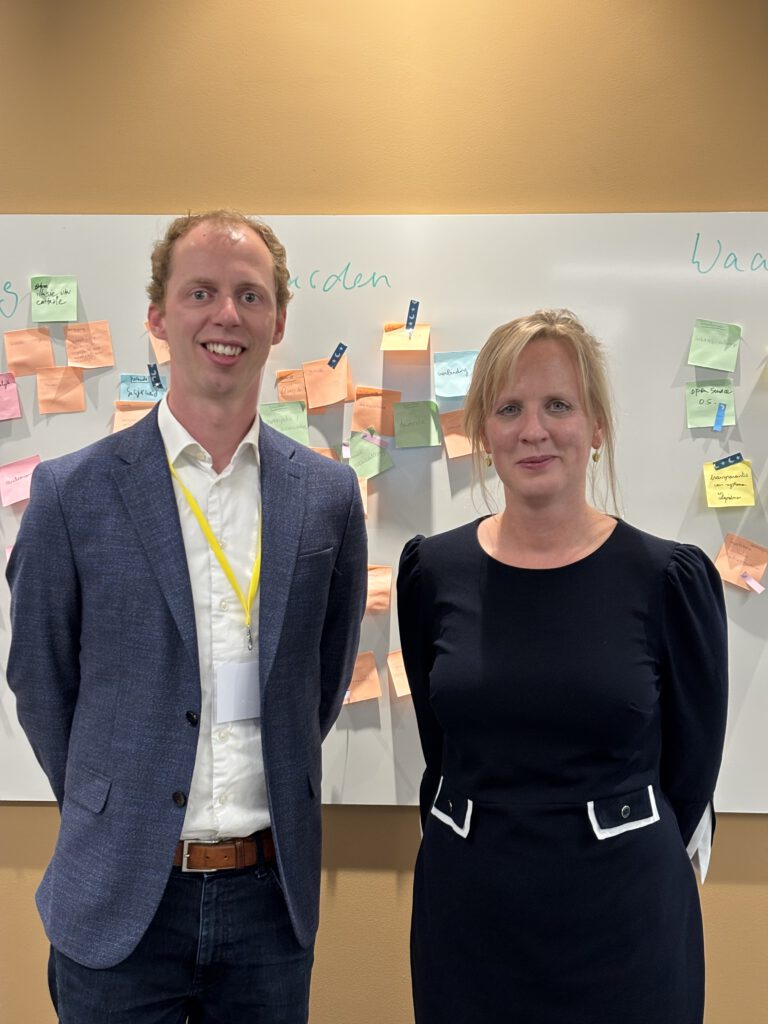
Pieter van Boheemen and Jiska Engelbert.
This report previously appeared on the website of the Centre for BOLD Cities