This is an automatic English translation of the Dutch original.
A look back at our experience with Donnie Maclurcan
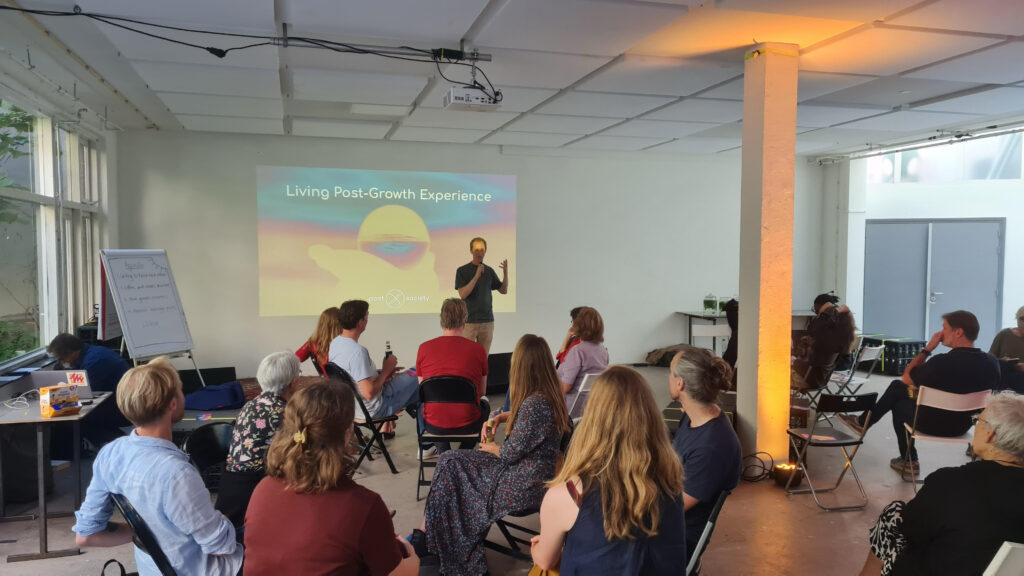
There are moments when you feel that the world can be different. That feeling took over last Friday, 19 September, when more than 50 people came together for a post-growth experience with Donnie Maclurcan, director of the Post Growth Institute
The feeling of a fair economy
Donnie did not begin with theory or models, but with a fundamental insight: everyone naturally senses what a fair economy looks like. An economy that is circular, in which money goes around and value is shared, not one in which wealth piles up linearly with a small group while the rest are left behind. Yet our current economic model is set up in exactly that linear way – and is therefore fundamentally unsustainable.
This opening statement touched something recognisable. Because indeed, somewhere we all know that the current system is not right, that it does not feel fair. What followed was an experience that let us feel how it could be instead.
From reflection to market
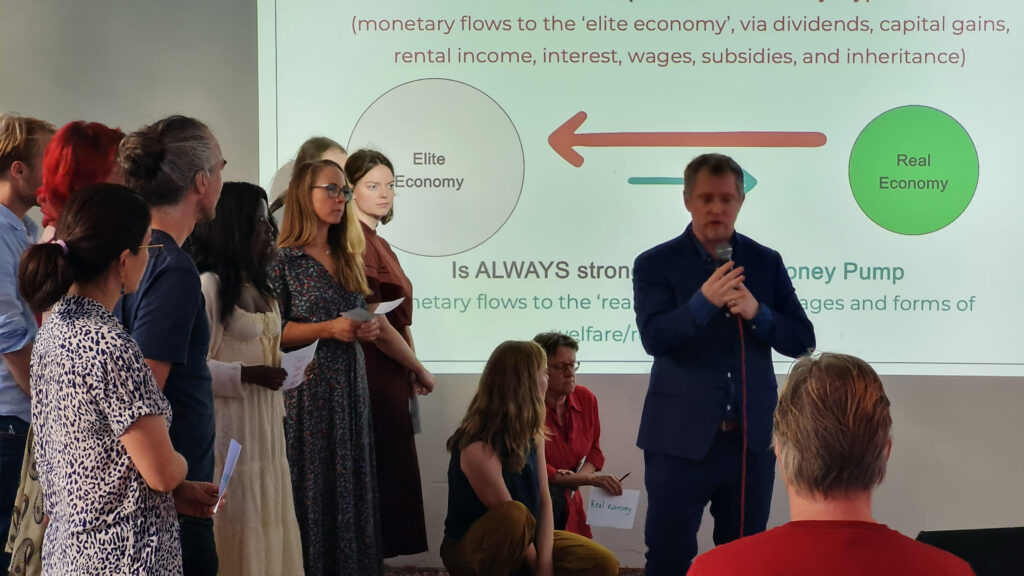
Donnie took us through a carefully built experience. We began with reflection on ourselves, got to know each other, and then did something special: an Offers and Needs Market. This method from the Post Growth Institute is a process in which people share and exchange their passions, knowledge, skills, resources and needs.
It was fascinating to see how quickly connections formed. People who did not know each other spontaneously began to work together, offer help, share knowledge. It felt natural, self-evident even. Donnie’s approach was always the same: first experience, only then gain insight. That way we did not just learn intellectually, but also felt how a different economy works.
The logic of post-capitalism
After this experience came a mini-lecture on post-growth economics that laid the theoretical foundation. Donnie clearly explained how our current system works: money = debt. In a capitalist system this automatically leads to money piling up with a small group, while debt ends up with a large group. This is not a bug in the system, but a feature.
A post-capitalist system is, by the way, really something different from communism, Donnie stressed. Under communism power centralises in a state model. Post-capitalism does not do that. It does not rule out market forces and competition, but ensures that money keeps circulating instead of piling up. It is not a utopia, but a practical reform of how we live together economically.
The post-capitalist world already exists
The most hopeful moment came when Donnie gave examples of organisations that already work according to post-capitalist principles. IKEA, Patagonia, the former Ford Foundation – these not-for-profit organisations prove that a different way of doing business is not only possible, but can also be successful. Although they did raise a few eyebrows too. IKEA is not everyone’s model of a sustainable world.
Even more intriguing was his example of the “Move Your Money” campaign in the United States. People moved their money from for-profit banks to credit unions. The result? A direct influence on the money flows in the economy. A fine example of how you can change the financial system through practical choices.
Celebrating and building on
This afternoon we also celebrated the second birthday of Stichting Post-X Society. Two years in which we have explored, experimented and made connections around the question: how do we build the future and a democratic society together?
The event showed that we do not only dream about new visions, but can actually experience them.
Get involved
The afternoon ended, but we are carrying on. Do you want to help build? There are concrete ways to take part:
- Join our Signal community: Stay up to date with new developments and connect with like-minded people via our communities
- Sign up for our newsletter: Receive regular updates about post-capitalist initiatives and events
Because as Donnie let us experience: the post-capitalist world is not a distant vision of the future, but is already coming into being. And that feeling, that is where change begins.